The Overlap Explained: Selling a Flying Freehold Without Alarm in 2026
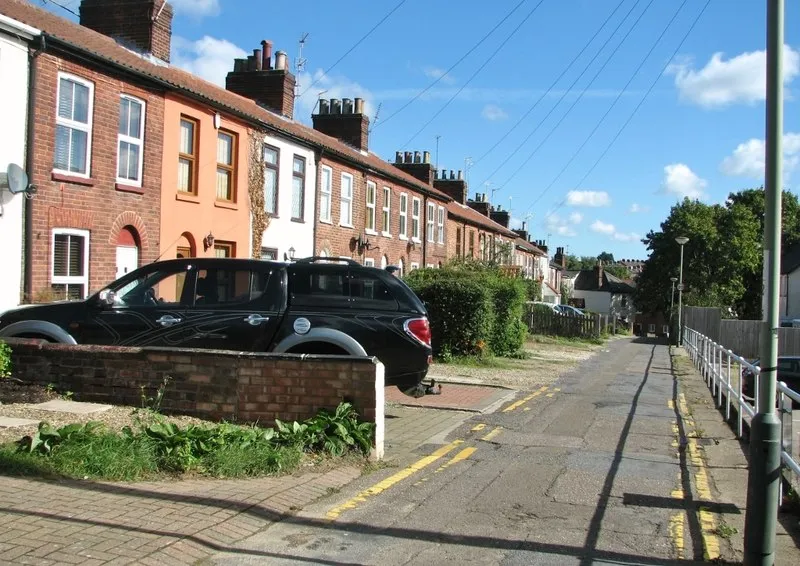
Photo: Evelyn Simak , CC BY-SA 2.0, via Wikimedia Commons
A flying freehold is one of those arrangements that sounds more alarming than it often is. In older terraces, converted houses and properties with rooms extending over a passage or neighbouring land, the ownership of the building does not stack neatly into vertical columns. Part of one freehold sits above or below another. The result can be a perfectly sound home with a title that requires explanation.
What a flying freehold actually is
In a conventional freehold house, the owner usually holds the land and the building above and below it. A flying freehold arises where part of a building overlaps another freehold title. A bedroom may extend over a neighbour's ground-floor passage. A balcony or store may sit over next door's land. A cellar may lie beneath a neighbouring property. The owner has a freehold interest in the overlapping space, but not in the land beneath or around it.
This is different from a leasehold. There may be no lease, no ground rent and no fixed term. Instead, the rights and obligations are usually set out in the deeds, sometimes with reciprocal covenants for support, access and repair. The difficulty is that those rights can be less comprehensive than a buyer or lender would like.
Why lenders hesitate
The main concerns are practical. If part of a home sits over a neighbour's land, what happens if the neighbour sells, develops or fails to maintain their property? Are there enforceable rights of support and access? Who insures the overlapping structure? If a repair is needed, who pays? A lender wants to know that its security can be used, sold and maintained without unnecessary legal friction.
Some lenders will proceed where the arrangement is long-established and supported by indemnity insurance or clear deed provisions. Others may refer the case to a specialist. The seller's task is not to pretend the arrangement is standard freehold. It is to provide the evidence that allows the lender and buyer to assess it.
The evidence a seller can assemble
The starting point is the title register and title plan. These should show the extent of the freehold and any rights or covenants. The seller should also obtain the historical deeds, particularly any document that created the overlap or granted rights of support, access or repair.
Useful additional evidence includes:
- A report from the seller's solicitor explaining the arrangement in plain terms.
- Any deed of variation or mutual covenant that clarifies repair obligations.
- A flying freehold indemnity policy, where one exists, together with its terms and limits.
- Buildings insurance details showing how the overlapping structure is covered.
- A structural survey or maintenance record for the overlapping part.
- Correspondence with the neighbour confirming practical arrangements for access and repair.
An indemnity policy is not a substitute for missing rights, but it can address certain enforcement risks. Its value depends on the cover, the insurer and the facts. A seller should not assume that any policy will satisfy a lender; the buyer's solicitor will need to review it.
Marketing without disguise
A flying freehold should be described accurately in the particulars. Calling it a share of freehold, or omitting the overlap, invites problems later. A neutral description such as 'a freehold house with a flying freehold arrangement over the neighbouring passage' is clearer and less alarming than ambiguity. The agent should be briefed so that early viewers receive the same explanation.
It also helps to provide a short explainer for buyers. This can set out what the overlap is, which deeds govern it, how repairs have been handled and what insurance exists. The aim is not to minimise the arrangement but to make it legible. A buyer who understands the structure is less likely to withdraw at the first mention of it.
Practical steps before listing
Before instructing an agent, the seller should ask a solicitor to review the title and identify any gaps in the rights or covenants. If a right of access or support is unclear, it may be possible to regularise it by agreement with the neighbour. That can take time, so it should be considered early.
The seller should also check the insurance position. If the overlapping part is insured under a standard household policy, the seller should confirm that the insurer is aware of the arrangement. If the neighbour's policy covers part of the structure, the seller should obtain details. Maintenance records and any recent structural reports will help.
Finally, the seller should speak to the neighbour. A short written confirmation of how access and repairs have been managed can be more persuasive than a string of assumptions. It also reduces the risk of a late dispute during conveyancing.
A clear title is not always a simple one
Flying freeholds have existed for generations and will continue to do so. They are not inherently unsaleable. The difficulty usually lies in unexplained title arrangements, not in the overlap itself. In 2026, a seller who provides clear deeds, sensible insurance evidence and a straightforward explanation is in a stronger position than one who hopes the issue will pass unnoticed.